Sabbatical Reads
Probably not comprehensive, but I'm trying to be better at tracking and writing down learnings and impressions before I forget them. In rough order of how I read them since starting the sabbatical.
- A Day in the Life of Abed Salama: Anatomy of a Jerusalem Tragedy by Nathan Thrall — a beautiful, searing book that everyone should read.
- The Undoing Project by Michael Lewis — the story of the collaboration between psychologists Daniel Kahneman and Amos Tversky, the minds that gave us behavioral economics. Interesting if you're into behavioral economics (or just curious about one of the most prolific academic/professional partnerships of the 20th century).
- These Truths by Jill Lepore — gorgeously written broad survey of US history. Having grown up in PR, I have long been self-conscious about my spotty US history knowledge (especially pre-20th century) and this book is a good place to start. Now patiently waiting in line for Lepore's new history of the constitution (We The People) to become available on Libby.
- A Carpet Ride to Khiva: Seven Years on the Silk Road by Christopher Aslan Alexander — read this before going to Uzbekistan and spending a week by myself in Khiva, and loved it. Beautiful window into an Uzbekistan freshly emerging from Soviet times, so quite different from the one I encountered in 2025 (which was nonetheless every bit as fascinating).
- The Silk Roads: A New History of the World by Peter Frankopan — should've read this a long time ago, but what better book to read while on the silk roads. Good reminder that the very center of the world always shifts, and just because you happened to be born during the peak of a given empire doesn't mean the world won't change under your feet.
- Benjamin Franklin: An American Life by Walter Isaacson — Franklin would be my answer to "if you could meet any historical character, whom would you pick." Felt a dash of Penn pride I hadn't felt in a while at having been formed at the university that was his brainchild.
- Alexander Hamilton by Ron Chernow — simply incredible life and story (that much is evident from the musical, but the full story is even more remarkable).
- The Hemingses of Monticello by Annette Gordon-Reed — Pulitzer Prize-winning history of Thomas Jefferson's "other" family: the woman he spent most of his life with and had at least six children with, who was his slave, and of her family and children and the world they inhabited.
- A Short History of Nearly Everything by Bill Bryson — became one of my favorite books of all time. Reminder of the sheer wonder that is this world and our extremely unlikely existence in it.
- How to Hide an Empire by Daniel Immerwahr — an essential book about the usually ignored history of the US' overseas possessions and how the American empire has shifted forms over time. I learned an embarrassing amount of Puerto Rican history from it, and couldn't have found a more relevant book to read while in Hawaii and about to embark on a months-long journey including Vietnam, Japan, and Korea.
- Breakneck by Dan Wang — there are lots of good books about modern China (the last one I remember reading being the excellent Age of Ambition by Evan Osnos), but this is the first one I have read post-pandemic and including first-hand accounts of China's extreme (to put it mildly) lockdowns. I generally agree with his assertion that both superpowers would be better off borrowing some things from the other, and found the "engineers vs. lawyers" framing both entertaining and insightful.
- Embracing Defeat: Japan in the Wake of World War II by John W. Dower — I've become fascinated with the topic of how countries recover from near complete devastation, and learning about this process in Japan while traveling around Vietnam reminded me of just how much of the world emerged from complete devastation way more recently than we usually stop to think about.
- The Vegetarian by Han Kang — one of the strangest books I've read. It will probably stay with me for a while.
- Treacherous Alliance: The Secret Dealings of Israel, Iran, and the US by Trita Parsi — this book has been on my "to be read" pile for 16 years and had to be picked up now (March 2026). It is "old" at this point but ever more relevant, illuminating, and depressing in terms of historical missed opportunities. Recommend to anyone interested in understanding the roots of the current conflict and the modern Middle East in general.
- The Orphan Master's Son by Adam Johnson — this will also stay with me for a while. I considered myself well-informed about North Korea before reading it, but this was so absurd that it prompted me to read a nonfiction book about it in parallel, which was fascinating and devastating in equal measure. The fiction and nonfiction narratives blended together at times, and I temporarily overdosed on North Korea, but highly recommend both.
- Nothing to Envy: Ordinary Lives in North Korea by Barbara Demick — a harrowing window into one of the world's most reclusive places by an author I have loved since reading her book on Tibet years ago.
- Stuff Matters by Mark Miodownik — enlightening and entertaining book about the materials that make up our world and that we largely take for granted. In another life I would have been a materials engineer.
- What I Talk About When I Talk About Running by Haruki Murakami — I've never read Murakami, figured being in Japan is a good time to start, and this was the only book small enough to carry with me for the next 6 months (while I await Kindle library loans of his too-large-to-carry novels). As someone who has struggled with PT issues getting in the way of running, really enjoyed this.
- The Wind-Up Bird Chronicle by Haruki Murakami — thoroughly enjoyed reading this book until the ending left me full of rage at how little of the plot resolved itself after 600 pages. (As a Latin American whose favorite book is One Hundred Years of Solitude, I am not averse to magical realism, but am apparently averse to wide-open, unexplained endings.) Still recovering from this before I can pick up another Murakami book.
- Genghis Khan and the Making of the Modern World, by Jack Weatherford — people who really know me know I love Central Asia and its history (though at his scale, Genghis Khan is just world history). Great read about a fascinating character. We flew direct from Seoul to Budapest when our sabbatical time in Asia came to an end, and I realized we flew the length of the Mongol empire (and marveled at the fact that they conquered territory so mind-blowingly vast that it is now a 13+ hour flight).
- Six Easy Pieces, by Richard Feynman — I'm on a quest to remediate a lack of science knowledge, and this is a fun and mostly accessible read for anyone. Hoping to graduate to being able to consume more of his work after getting through online physics courses.
- Seven Brief Lessons on Physics, by Carlo Rovelli — devoured in a single afternoon in a really beautiful cafe in Tokyo. Now want to read all his other books.
- Excellent Advice for Living, by Kevin Kelly — I've been fascinated with Kevin Kelly since discovering his work via the Tim Ferriss podcast (what an interesting life he has led, and what more could one aspire to). When I have an apartment and coffee table again, his 1,000-page photography book of his travels through Asia will be on it. I loved this little book and highlighted much of it.
- 1929: Inside the Greatest Crash in Wall Street History and How It Shattered a Nation, by Andrew Ross Sorkin — interesting and timely, given the exuberant markets we are living in.
- We Do Not Part, by Han Kang — I find Han Kang's (the first Asian woman and the first Korean to win a Nobel Prize in Literature) writing haunting and it puts me in a dark mood, but I felt I needed to read at least some of her work while in Korea, and this one taught me about a horrifying period of recent Korean history that I had never heard of. A book I am glad to have read and learned from, even if I didn't particularly enjoy reading it.
- Becoming Kim Jong Un, by Jung H. Pak — a more recent study of North Korea from a CIA analyst that provided a sober reminder of how close we got to catastrophe during Trump 1.0. Also presents how much DPRK has changed (and how it hasn't changed) under Kim Jong Un.
- ROAR: How to Match Your Food and Fitness to Your Unique Female Physiology, by Stacy Sims — almost all health and wellness studies and advice are based on male data. Very interesting to learn where conventional advice (e.g., fasting!) just does not work the same for female physiology.
- Runnin' Down a Dream: How to Thrive in a Career You Actually Love, by Bill Gurley — I've wanted to read this book since I heard Bill on a podcast, and found some of the stories in it really inspiring (Julia Child didn't learn to cook until she was my age!).
- Designing Your Life: How to Build a Well-Lived, Joyful Life, by Bill Burnett and Dave Evans — helpful reframing of how to approach things.
- Without You, There Is No Us: Undercover Among the Sons of North Korea's Elite, by Suki Kim — I really need to stop reading books about North Korea unless I decide to become a very specialized political analyst, but I find it so fascinating and this book turned out one of the most interesting of the ones I read (at least tied to Nothing to Envy), because it is a memoir by a South Korean American writer who pretended to be a missionary so she could teach English in Pyongyang.
- How the World Really Works: A Scientist's Guide to Our Past, Present and Future, by Vaclav Smil — great read to put in perspective all the energy it takes to supply us with the materials most essential to our survival and civilization (amonia, plastics, steel, and cement) — energy we invariably derive largely from hydrocarbons. Essential for anyone who wants to think about decarbonization from a starting point based in reality. Oddly comforting in that the extent of our reliance is such, that there are basically endless problems to work on that would move towards the goal of keeping this planet liveable.
- Purple Hibiscus, by Chimamanda Ngozi Adichie — binged in two days. She has my heart since I read Americanah. I'm now really sad that I have no more of her novels to read for the first time.
- The Order of Time, by Carlo Rovelli — Mixed feelings, though I continue to love his writing. Just not sure that the intricacies of time according to physics (the only elementary equation pointing to the arrow of time being heat transfer/entropy) matter much for our lived experience of time, which is certainly one directional and a use-it-or-lose-it proposition.
- How to Win Friends and Influence People, by Dale Carnegie — should be required reading for humans.
- The Miracle of Mindfulness: An Introduction to the Practice of Meditation, by Thich Nhat Hanh — for me personally, not as effective as just using The Way (meditation app), but found parts of this very beautiful, especially the last few pages on Thich Nhat Hanh's tour of the US during the Vietnam War.
- The Rational Optimist: How Prosperity Evolves, by Matt Ridley — Another Bill Gurley recommendation. Optimism about the state and direction of the world doesn't always come as naturally to me as I wish it did (though I strive for Madeleine Albright's "an optimist who worries" characterization), so I enjoyed reading this. Didn't agree with the author on everything, but overall great read that reminded me to be grateful for having been born in the late 20th century.
- Build: An Unorthodox Guide to Making Things Worth Making, by Tony Fadell — Fun read and widely applicable even if you're not building a hardware company. Wish I had read this earlier in life (though it was only published five years ago).
- The Fire Next Time, by James Baldwin — Essential book that I should have read a long, long time ago.
- Helgoland, by Carlo Rovelli — I still don't understand quantum physics (will take solace in Feynman stating that no one does really), but enjoyed this a lot and remain undeterred in my quest to finally learn physics.
- The Nazi and the Psychiatrist: Hermann Göring, Dr. Douglas M. Kelley, and a Fatal Meeting of Minds at the End of WWII, by Jack El-Hai — Got this in a beautiful Berlin bookshop the day after visiting Sachsenhausen concentration camp, where the only appropriate reaction is (1) horror (2) to question how this was made possible. This is the fascinating story of the American psychiatrist who assessed Göring and the other high-ranking nazis ahead of the Nuremberg trial, and how he came to conclude that there was nothing identifiably different about most of them — you could find people like them in every country, and what happened there could happen again anywhere. [Sidebar, please watch The Zone of Interest.]
- The Power of Now: A Guide to Spiritual Enlightenment, by Eckhart Tolle — I'm trying hard to fix my relationship with time. A lot of this book was beyond me and it took me ages to get through, but some of it was beautiful and accessible and probably will be helpful.
Audiobooks
(Went on a tech history binge at some point. Recommend The Innovators to everyone.)
- The Innovators: How a Group of Hackers, Geniuses and Geeks Created the Digital Revolution by Walter Isaacson
- The Optimist: Sam Altman, OpenAI, and the Race to Invent the Future by Keach Hagey
- The Contrarian: Peter Thiel and Silicon Valley's Pursuit of Power by Max Chafkin
Books about countries we traveled to that I couldn't find or get on Kindle:
- Vietnam: A New History, by Christopher Goscha
- Alone in Japan: A Journey to the Future, by Tom Feiling
- Letter from Japan, by Marie Kondo and Marie Iida — Marie Kondo's love letter to Japan is the only book I've ever consumed that I think is better in audio than print. They found the perfect narrator for this book. Some of it is about her rituals and her business, but the book is also about aspects of Japanese culture and history that she wants to pass on to her children, and I really loved listening to this while on long bus/train rides in Japan.
- Korea: The Impossible Country, by Daniel Tudor
- Prague Winter: A Personal Story of Remembrance and War, 1937-1948, by Madeleine Albright — Having met Secretary Albright and worked for her firm will forever be one of the great honors of my life. Learning about the history of the Czech people in her own voice was the perfect way to spend multiple trains and bus rides crisscrossing that beautiful, remarkable country.
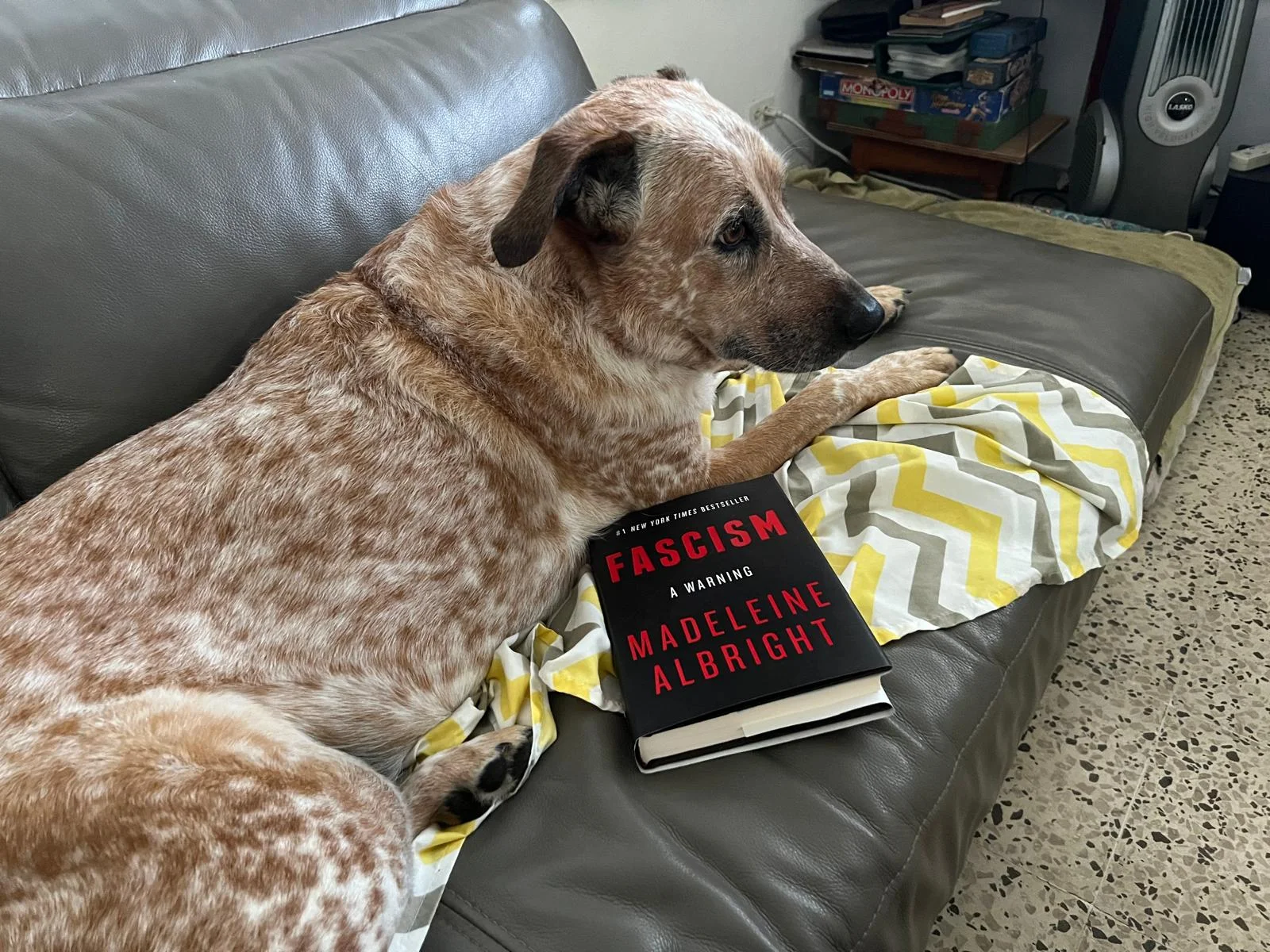
Sage sitting on my book signed by Madeleine Albright, Vega Baja, Puerto Rico, May 2022.